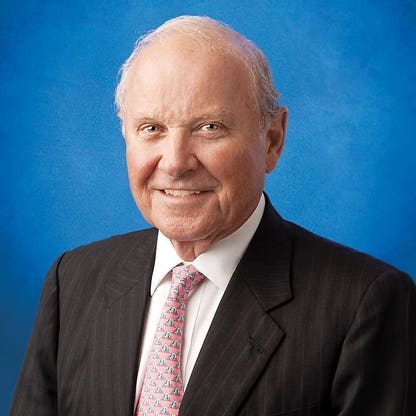
Charles B. Johnson's $6.1 Billion Net Worth: Franklin Templeton & Giants
The story of Charles B. Johnson is one of immense financial prowess, visionary leadership, and a significant footprint in both global finance and America's favorite pastime. With an estimated
charles bartlett johnson net worth of approximately $6.1 billion, his remarkable journey began not with a splash, but with a quiet entry into his father's nascent investment firm. From transforming Franklin Resources into a multi-billion-dollar asset management giant, now known as Franklin Templeton, to becoming a principal owner of the beloved San Francisco Giants, Johnson's career exemplifies strategic thinking and enduring dedication. This article delves into the various facets that contributed to his staggering wealth and lasting legacy, exploring the pivotal moments and decisions that defined his path.
Born on January 6, 1933, in Montclair, New Jersey, Charles B. Johnson’s early life was marked by a blend of academic pursuit and practical experience. His father, Rupert Harris Johnson, laid the groundwork for the family's financial empire by founding Franklin Distributors in 1947. Despite his parents' divorce during his childhood, which led him to live with his mother and four siblings, Charles pursued a strong education. He attended Montclair High School before graduating from Yale University in 1954 with a degree in history. During his time at Yale, Johnson was not only a scholar but also an athlete, playing as an offensive guard for the football team. His participation in the Reserve Officers’ Training Corps (ROTC) also led to a period of service as a lieutenant in the U.S. Army, stationed in Germany—experiences that undoubtedly instilled discipline and leadership qualities.
The Foundation of a Fortune: Franklin Templeton's Global Ascent
Charles B. Johnson's entry into the professional world at his father's mutual fund company, Franklin Distributors (later Franklin Resources), in 1957 marked the beginning of an extraordinary career. At just 24 years old, he stepped into the role of chief executive officer, a position he would hold for an astonishing 56 years, until 2004, eventually retiring as chairman in 2013. This remarkable tenure is a testament to his unwavering commitment and strategic acumen.
Under Johnson's stewardship, Franklin Resources embarked on an unparalleled trajectory of growth. What began with a modest $2.5 million in assets under management (AUM) mushroomed into an astonishing $800 billion by the time of his retirement as chairman. This meteoric rise wasn't accidental; it was the result of a meticulously planned strategy centered on expansion, diversification, and astute acquisitions.
A pivotal moment in the company's evolution occurred in 1992 with the acquisition of Templeton, Galbraith & Hansberger Ltd. for a substantial $913 million. This strategic move was transformative, rebranding the company as Franklin Templeton Investments and significantly broadening its global reach and diversifying its investment offerings across a wide variety of mutual funds. This acquisition allowed the firm to tap into new markets and provide a more comprehensive suite of financial products, a critical factor in its long-term success. The ability to identify and integrate such significant assets into the core business demonstrated Johnson's foresight and capacity for bold decision-making, setting the stage for Franklin Templeton to become a truly global investment powerhouse. For more on this, you can explore
How Charles B. Johnson Built a Global Investment Powerhouse.
Johnson’s leadership style emphasized a long-term vision, focusing on consistent growth and adaptability in the ever-changing financial landscape. His commitment to building a robust and resilient firm allowed Franklin Templeton to navigate market fluctuations and emerge stronger. This dedication not only secured the firm's financial standing but also established a legacy of trust and reliability in the investment community.
The family's deep roots in the company continued into the next generation. In 2019, his daughter, Jennifer M. Johnson, was appointed chief executive officer, continuing the family's leadership tradition. His son, Greg Johnson, also serves as executive chairman, ensuring the continuity of the family's influence and principles within the firm. This strategic succession planning highlights a commitment to enduring leadership and a testament to the strong foundation Charles B. Johnson built.
Beyond the Boardroom: Charles B. Johnson and the San Francisco Giants
While Charles B. Johnson's name is synonymous with financial titans like Franklin Templeton, his influence extends far beyond the world of investment banking into the realm of professional sports. A significant component of his considerable
charles bartlett johnson net worth and public profile stems from his role as the largest shareholder of the San Francisco Giants, owning a substantial 26% of the Major League Baseball team.
His involvement with the Giants began in 1992, the same year as the landmark Templeton acquisition, when he purchased his share alongside Peter Magowan and Larry Baer. This move was not merely a financial diversification but a deeply personal investment in a community asset. Owning a major league baseball team brings with it a unique blend of business acumen, civic pride, and a passion for the game. For Johnson, it meant contributing to the legacy of a storied franchise and connecting with millions of fans.
Under Johnson's ownership, the San Francisco Giants experienced a golden era, clinching three World Series championships in 2010, 2012, and 2014. These victories not only brought immense joy to the city of San Francisco but also significantly enhanced the value and brand of the franchise. His tenure as owner saw a transformation in the team's fortunes, moving from periods of struggle to becoming a dominant force in MLB. This success reflects not only the talent on the field but also the stable and committed ownership that provided the resources and strategic direction needed for sustained excellence.
The decision to invest in a sports team, particularly a major league franchise, often represents more than just a financial calculation for billionaires. It's an opportunity to engage with a different kind of asset – one steeped in community, tradition, and collective passion. While the financial returns can be significant, the intangible benefits of contributing to a city's identity and sharing in the triumphs of a beloved team are often equally, if not more, compelling. This dual focus on finance and sports exemplifies
The Billionaire Journey of Charles B. Johnson: Finance & MLB.
A Billionaire's Blueprint: Legacy, Leadership, and Family
Charles B. Johnson's journey from a young man taking the reins of his father's company to a multi-billionaire businessman and influential sports owner offers a compelling blueprint for success. His legacy is multifaceted, built on decades of unwavering leadership, strategic foresight, and an astute understanding of market dynamics. His ability to grow Franklin Templeton from a small regional firm into a global financial powerhouse is a testament to the power of consistent vision and a willingness to embrace transformative changes, like the Templeton acquisition.
Beyond his professional achievements, Johnson has also been noted as a significant Republican mega-donor, reflecting his engagement in political discourse and his commitment to specific ideologies. Despite his high profile as a billionaire and sports owner, the Johnson family is known for maintaining a relatively low profile, choosing to focus on their business and private life. This balance between immense public responsibility and personal discretion is a characteristic often found among long-standing business dynasties.
The principles that guided Charles B. Johnson's career – long-term thinking, strategic investment, and cultivating strong leadership – are invaluable lessons for aspiring entrepreneurs and business leaders. His commitment to a family business, and ensuring its continuity through his children, underscores the importance of succession planning and instilling core values across generations. His influence on both the financial sector and professional baseball has cemented his place as one of America's most impactful businessmen of his era.
Conclusion
Charles B. Johnson's life is a remarkable narrative of ambition, dedication, and monumental achievement. With a
charles bartlett johnson net worth that reflects a lifetime of strategic brilliance, he fundamentally reshaped the investment landscape through Franklin Templeton and brought championship glory to the San Francisco Giants. From his humble beginnings and military service to his unparalleled tenure as CEO, Johnson built an enduring legacy founded on financial acumen and a profound commitment to excellence. His story serves as a powerful reminder that true wealth is not just measured in billions, but in the lasting impact one leaves on industries, communities, and future generations.